
Render pipeline
Every pixel of JOID, from a rectangle to a 3D model, reaches the render bridge through one method: draw(primitive, buffer).
This page follows a drawing from the node to the API of the backend, then describes each piece of data the bridge reads.
The contract itself is on Render bridge; the user side of drawing is on Drawing shapes and text.
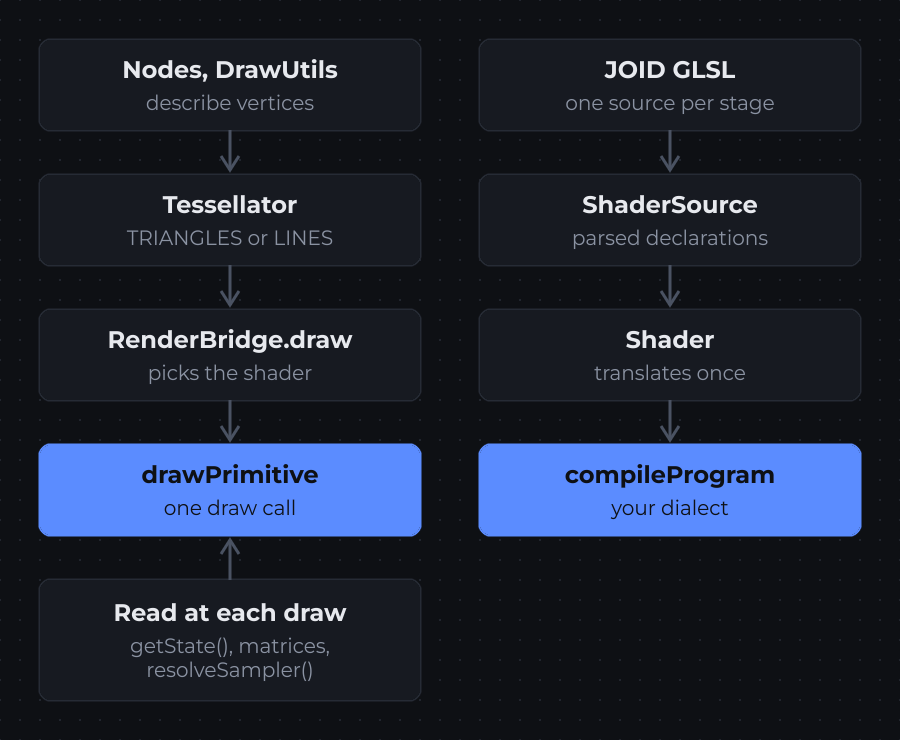
drawPrimitive receives each draw with the state of that moment, compileProgram receives each shader once, translated from JOID GLSL.
A frame
Section titled “A frame”For the render bridge, a frame of UIBridgeRegistry.frame is screen(...) on a resize, the updates of the UIs outside the frame, then beginFrame(), the draws of every UI bridge and endFrame() (Render bridge, The frame lifecycle).
A draw call
Section titled “A draw call”Nodes and the drawing API never build GPU commands: they describe vertices to the Tessellator, which turns every mode into one of the two primitives that a bridge draws.
| Mode of the tessellator | Reaches the bridge as |
|---|---|
TRIANGLES | TRIANGLES |
QUADS | TRIANGLES, two per quad |
POLYGON | TRIANGLES, a fan from the first vertex |
LINES, LINE_STRIP, LINE_LOOP | LINES, two vertices per segment |
| any line mode with a width other than 1 or smoothing on | TRIANGLES, drawn by the line variant of the shader |
RenderBridge.draw then picks the shader and calls your RenderBridge.drawPrimitive with the primitive, the buffer and the shader.
Vertices
Section titled “Vertices”A VertexBuffer holds getCount() vertices of 32 bytes each, in a direct ByteBuffer in native order.
VertexAttribute describes the layout:
| Attribute | Location | Offset | Content |
|---|---|---|---|
POSITION | 0 | 0 | 3 × float |
TEXTURE_COORDINATE | 1 | 12 | 2 × float |
COLOR | 2 | 20 | 4 × unsigned byte, normalized, RGBA |
NORMAL | 3 | 24 | 3 × signed byte, normalized |
Bytes 27 to 31 are padding.
isTexture(), isColor() and isNormal() tell which attributes the drawing filled, and a missing attribute takes a default:
- texture coordinates
(0, 0)and normal(0, 0, 1): on OpenGL, constant vertex attributes; on an API without them,VertexFill.completecopies the buffer and writes the defaults; - color: the current color of the state, which the translated shader picks when the buffer has no color, so the bridge does nothing.
The render state
Section titled “The render state”RenderState is the whole fixed-function state of a draw, held by RenderBridge.getState and changed by the core between draws.
| Property | Default | Meaning |
|---|---|---|
color(red, green, blue, alpha) | opaque white | The color of the vertices without a color. |
blend | BlendState.DISABLED | Equation and factors; BlendState.NORMAL and BlendState.PREMULTIPLIED are the usual ones. |
depthTest, depthWrite | off, on | Depth comparison LESS, and depth writes. |
colorWrite | on | Writes to the color buffer. |
cull | off | Back-face culling, counter-clockwise front faces. |
stencil | StencilState.DISABLED | Function, reference, mask and operations, for the screen only. |
alphaCutoff | 0F | Discards the fragments whose alpha is at most this value; 0F turns the test off. |
lighting | off | Diffuse lighting from the normals, applied by the shaders. |
lineWidth, lineSmooth | 1F, off | Read by the tessellator, which turns wide or smooth lines into triangles. |
viewport(x, y, width, height) | set by screen | The viewport, in pixels of the target. |
frameBuffer | null | The target framebuffer; null is the screen. |
texture, textureFilter, textureWrap, textureMipmap | none, NEAREST, REPEAT, on | The texture of the state, how to sample it, and whether its mip levels may be used. |
shader | null | The bound shader; null draws with the default one. |
Several values never reach a draw as such: the shader turns the alpha cutoff, the line width and the current color into uniforms (Shader translation).
Matrices and coordinates
Section titled “Matrices and coordinates”Read RenderBridge.getProjection and RenderBridge.getModelView at the draw; Shader.builtins writes them, with the normal matrix, into the uniforms of the shader.
The clip space is the one of OpenGL: x and y from -1 to 1, with y up.
An API whose y goes down flips its viewport, and the depth range is on Depth.
Textures and samplers
Section titled “Textures and samplers”In drawPrimitive, bind resolveSampler(sampler) on the unit of each sampler that the shader declares (Render bridge gives its fallbacks).
Each returns a SamplerBinding: the texture, and a TextureSampling with its filter, its wrap and whether it has mip levels.
TextureSampling.isMipmapFilteredistruefor aLINEARfilter on a texture with mip levels: sample with linear filtering between the levels too.- A
NEARESTsampling reads level 0 only, even on a texture with mip levels: onlyisMipmapFiltered()turns the levels on, as the OpenGL and Vulkan backends do. - A wrap that
IRenderBridge.canWraprefuses reaches you asCLAMP_TO_EDGE; when the refused wrap isCLAMP_TO_BORDER, the shaders also emulate its transparent border.
Mipmaps
Section titled “Mipmaps”JOID computes the mip chain in the core, so that every backend fills the same levels.
A texture has no mip levels until mipmap(true); then its MipmapChain has floor(log2(max(width, height))) + 1 levels, each half the size of the previous one and at least 1×1.
Override getMaxLevels(width, height) in your Texture to cap the chain.
Each level is a linear copy of the level before it, never of level 0, and never through a driver function that picks its own filter.
MipmapChain.forEachStep calls you once per level with both sizes: copy level n - 1 into level n with a linear filter.
Hook of Texture | Called when | Fill |
|---|---|---|
allocateStorage(chain) | The size or the number of levels changes. | Storage for every level of the chain, before any copy. |
uploadPixels(pixels, chain) | New pixels arrive for level 0. | Level 0, then every other level with forEachStep. |
generateMipmapLevels(chain, allocatedLevels) | Mipmaps are turned on for a texture that is already allocated. | The missing storage when allocatedLevels differs, then the levels, keeping level 0. |
deleteStorage() | The texture is deleted, once. | Nothing: release the storage. |
The OpenGL module copies each level with a framebuffer blit, or with a drawn quad when the context cannot blit (base-opengl).
Clean up between frames
Section titled “Clean up between frames”At the start of its drawing, each UI bridge releases the resources whose owners were collected and the framebuffers of the effects unused for a while. A backend that defers destruction until the GPU is done (Vulkan does) receives these deletions in the middle of a frame: keep them until the GPU has finished reading the object.